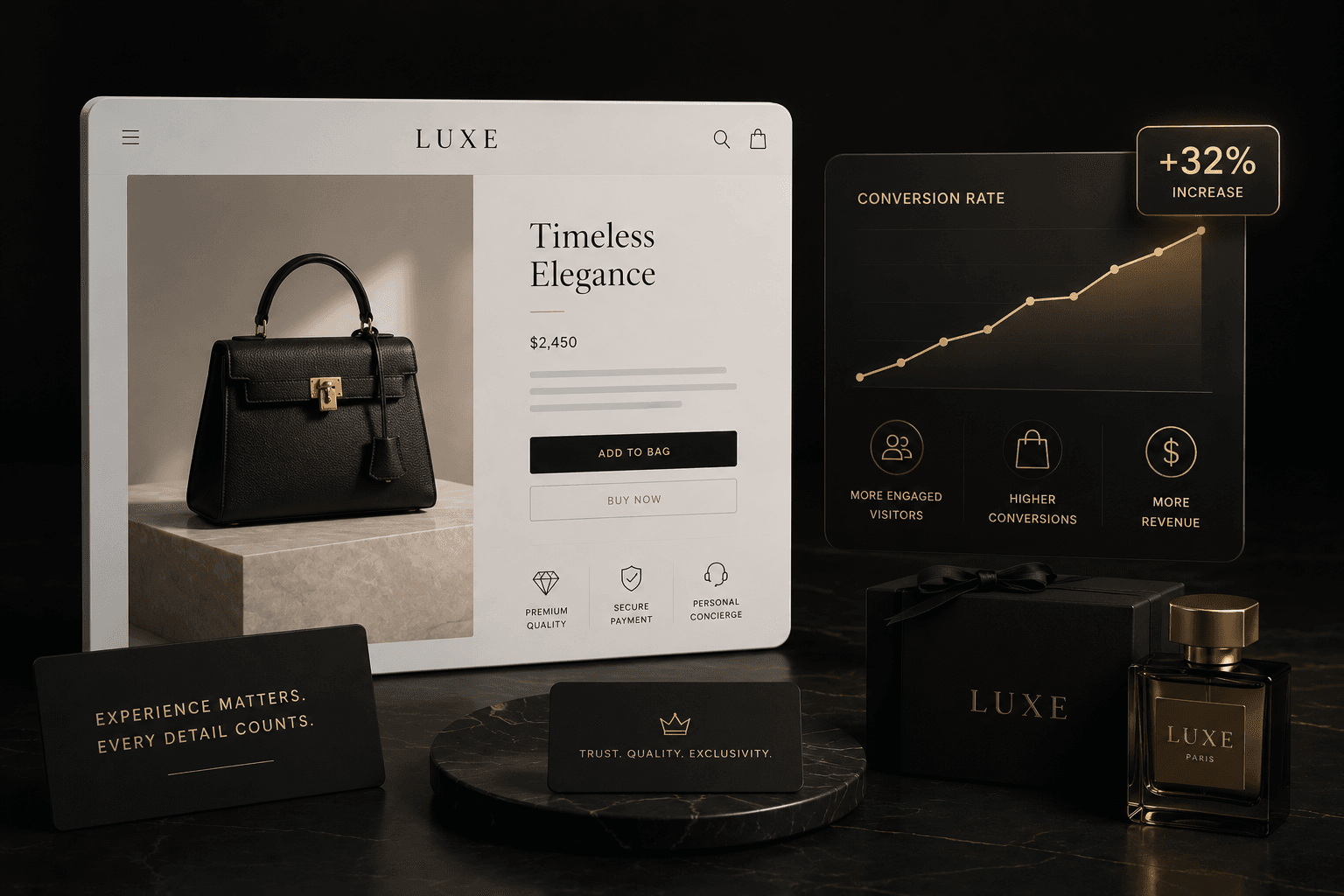
A luxury conversion rate optimization agency needs to understand that luxury ecommerce conversion rates run structurally lower than the broader ecommerce average, and that’s not necessarily a problem to fix.
Luxury ecommerce conversion rates run structurally lower than the broader ecommerce average, often 0.8–1.5% compared to a general benchmark closer to 2–3%, and that’s not necessarily a problem to fix. Longer consideration cycles and higher price points mean fewer, larger purchases rather than high-volume conversion.
Luxury conversion rate optimization agency benchmarks are different
Comparing a luxury jewelry brand’s 1% conversion rate against the ecommerce-wide 2.5–3% average and concluding something’s broken is a mistake. A luxury shopper researching a $2,000 purchase across multiple sessions and devices behaves nothing like someone buying a $30 impulse item, the funnel and the benchmark both need to reflect that.
What CRO actually looks like for luxury brands
- Trust and craft signals over urgency tactics. Countdown timers and stock scarcity messaging tend to feel at odds with luxury positioning, the goal is confidence, not urgency.
- High-fidelity product presentation. Photography and video quality carry more conversion weight here than in most categories. This is often the single highest-leverage fix.
- White-glove checkout, not the fastest checkout. Concierge-style options (personal shopper contact, gift wrapping detail, appointment booking) can outperform pure speed-focused checkout optimization.
- Cross-session tracking. Luxury purchases often span multiple visits, measuring single-session conversion rate alone understates real funnel health.
Where the fundamentals still apply
Even with different benchmarks, basic friction still matters. A slow-loading product page or a confusing checkout still costs sales, regardless of price point. The core CRO fundamentals still apply; the priorities and benchmarks around them shift.
Apply these principles as a lens for every future funnel decision, not just a one-time review.
When in doubt on any specific tactic, ask whether it would feel appropriate coming from a trusted specialty boutique with an in-person relationship with the customer. That lens tends to clarify what belongs in a luxury ecommerce experience and what doesn’t.
Luxury ecommerce is still ecommerce, the fundamentals of a working funnel still apply underneath the category-specific nuance. Don’t let the emphasis on brand positioning become an excuse to skip basic technical and usability fundamentals that matter regardless of price point.
The overarching principle for luxury CRO is that every friction-reducing tactic still needs to pass through the lens of whether it reinforces or undermines the premium positioning the brand has built. A fast checkout that feels cheap is a worse outcome than a slightly slower one that feels considered.
Learning from luxury retail beyond ecommerce
Physical luxury retail has decades of practice balancing exclusivity with genuine customer service, much of that thinking translates directly to ecommerce CRO for luxury brands, more so than generic mass-market ecommerce advice, which is worth keeping in mind when evaluating any CRO recommendation’s source.
Testing carefully in a luxury context
Because luxury audiences are smaller and each customer relationship carries more long-term value, be more conservative with test scope than you would on a high-volume mass-market store, a poorly received test variant risks brand perception in a way that matters more here than in lower-consideration categories.
The role of limited availability and waitlists
Genuine scarcity, a waitlist for a limited production run, notification for restocks of a specific size, tends to work well for luxury brands specifically because it reflects real supply constraints rather than manufactured urgency, which is the distinction that makes it feel authentic rather than manipulative to a discerning luxury shopper.
International shipping and customs transparency for luxury goods
High-value international orders carry real customs and duty complexity that, if left unclear until after purchase, creates a poor post-purchase experience even when the sale itself converted successfully, transparent upfront communication about international fees is worth the same attention as domestic checkout clarity.
Balancing exclusivity with accessibility
Luxury brands sometimes over-correct toward exclusivity in ways that create unnecessary friction, requiring account creation before viewing prices, for instance, can feel gatekeeping rather than premium. The goal is signaling quality and craft, not making the buying process itself harder than it needs to be.
Editorial and storytelling content’s role in luxury conversion
Long-form brand storytelling, craftsmanship detail, and editorial content often influence luxury purchase decisions more than they would for lower-consideration categories, worth measuring engagement with this content as a leading indicator, not just treating it as separate from your conversion funnel.
Measuring success beyond single-session conversion rate
Because luxury purchases often span multiple research sessions and devices, single-session conversion rate understates real funnel performance. Assisted conversion metrics, tracking a purchase back to earlier sessions that contributed to the decision, not just the final session, give a more accurate picture for high-consideration categories.
The role of customer service in luxury conversion
For high-price-point purchases, a responsive pre-sale customer service channel (live chat, direct contact with a specialist) often converts hesitant browsers better than any on-page copy change. This blurs the line between “customer service” and “CRO” in a way that’s less relevant for lower-consideration categories.
Common questions about luxury ecommerce CRO
Should luxury brands use urgency tactics at all?
Sparingly, and framed around genuine scarcity (limited production runs, seasonal collections) rather than artificial countdown timers, which can undermine premium positioning.
Does mobile matter as much for luxury as for mass-market ecommerce?
Increasingly yes, mobile research behavior is high even for luxury purchases, even when the final purchase happens on desktop or in a different session.
How should luxury brands think about return rates in CRO?
High return rates can indicate a product-page information gap (sizing, materials, fit) rather than a pricing or demand problem, worth investigating before assuming returns are simply a cost of doing business.
Shopify’s general conversion tactics guide covers the funnel fundamentals that still apply underneath category-specific benchmarks.
Any luxury conversion rate optimization agency worth hiring should understand these category-specific benchmarks first.
Any luxury conversion rate optimization agency worth hiring should lead with this distinction, not a generic ecommerce benchmark.
Related reading
- What Is Conversion Rate Optimization?
- The Ecommerce CRO Checklist: Product Page to Checkout
- Revenue Leakage in Ecommerce: Where Stores Actually Lose Money
Optimization tuned to your actual benchmarks.
Eulav adjusts to your store’s real category, not a generic ecommerce average.
Try Eulav freeWhere Eulav fits
Make the most of every visit and see a measurable lift in your first 30 days, or get a refund. Eulav is an AI-powered revenue optimisation platform for ecommerce brands, including Shopify stores, built by a team with over a decade in DTC revenue optimisation. It scans your store, shows where you can sell more, including any hidden blockers, and measures each optimisation you approve. Each optimisation is shown to some of your visitors first, and nothing goes live without your approval.
Spending on traffic? Whether a visit came from paid, organic or email, Eulav helps it convert, so your traffic spend earns more. At 1,000 visits, lifting conversion from 2% to 2.5% turns 20 orders into 25, with no extra ad spend.
Built for your category: Shopify CRO for fashion, beauty, supplement, jewellery, footwear brands. Comparing tools? See alternatives to Intelligems, Shoplift, Hotjar, Convert.
Make the most of the traffic you already invest in. Start with free opportunity finding and 2 optimisations. No card, 60-second setup.