
Gift with purchase marketing gives shoppers an extra item when they make a qualifying purchase. For an ecommerce brand, the useful question is whether the offer helps customers choose the right products while protecting the economics of the order.
Start with a clear offer, check what it costs to deliver, and decide how you will evaluate it. A gift is an idea to test, rather than a reason to assume revenue will improve.
What does gift with purchase mean?
Gift with purchase, often shortened to GWP, describes a promotion where an extra item is included with an eligible purchase. The gift might be a product sample, a complementary item, or something available for a particular offer.
Make the conditions easy to understand before a shopper reaches checkout:
- What purchase qualifies for the gift?
- Is the extra item free, or is it a paid add-on?
- Does the shopper need to reach an order threshold?
- Are there stock, timing, or eligibility limits?
- What happens if the qualifying order is returned?
Use consistent wording across the product page, cart, checkout, and order confirmation. Customers should be able to understand the offer without piecing together rules from different parts of the store.
How to plan a gift offer around your margins
Before choosing a gift or threshold, review the product margin and the additional cost of the promotion. Include the gift’s cost to the business, packaging, picking and packing, and any change to shipping costs.
For a threshold offer, consider testing a qualifying amount above a typical basket. Check whether customers can reasonably reach it and whether contribution margin after the gift and fulfilment costs remains acceptable. Treat the threshold as a hypothesis for your store, rather than a benchmark borrowed from another category.
Separate the gift’s advertised retail value from what it costs you to deliver. Both can matter to the decision, but they answer different questions: how you explain the offer to a customer and whether the offer makes commercial sense for the business.
Choose the outcome you want to examine before launching. That might be order value, conversion, repeat purchasing, or contribution margin. Reviewing them together can help you avoid choosing an offer on the strength of a single metric.
Gift-with-purchase ideas to test
Use the store goal to shape the hypothesis, then choose an offer your team can deliver consistently.
Product discovery
Consider a relevant sample or complementary product when you want customers to explore another part of the range. Decide what would count as useful follow-up behaviour and how you would observe it.
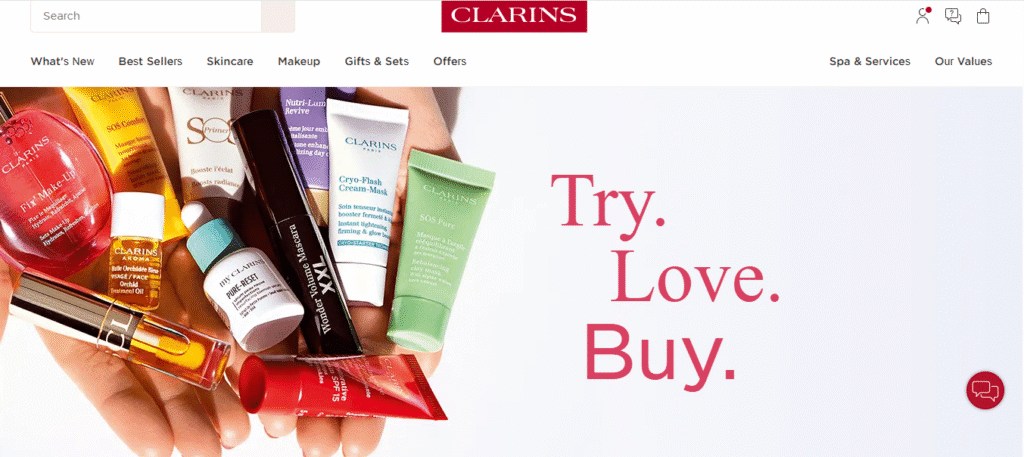
Clarins: a product-discovery illustration. The screenshot below pairs beauty products with the message “Try. Love. Buy.” It illustrates a trial-focused presentation; it does not specify the purchase conditions for receiving a sample. When planning a sample gift, make those conditions clear alongside the offer.
Basket building
A threshold gift is an option to test when the goal is to explore larger baskets. Check the cost of the offer and whether the qualifying amount is clear wherever the promotion appears.
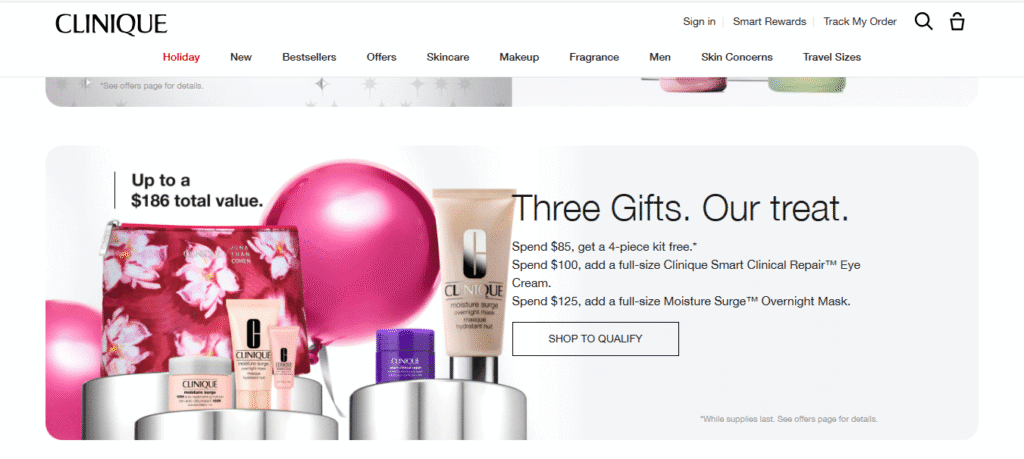
Clinique: a threshold-based gift example. In the screenshot below, different spending thresholds unlock different gifts. The useful detail is how the offer connects each qualifying spend to a specific gift. Treat this as an illustration of the promotion structure, rather than evidence of higher sales or repeat purchasing.
A limited promotion
If the gift genuinely has limited availability, explain that accurately. Confirm inventory and substitution rules before using scarcity language. Avoid suggesting that limited availability alone establishes an improvement in sales.
Repeat purchasing
If you want to examine repeat orders, define which customers are eligible and what return behaviour you will measure. Account for customers who might have purchased again without receiving a gift.
Gift with purchase or a discount?
A gift adds an item to the offer, while a discount changes the price the customer pays. Either approach needs to be evaluated against the same business goal.
Compare the offer costs, shopper response, contribution margin, returns, and operational effort. Avoid assuming that a gift’s advertised value makes it a better choice, or that a discount is automatically less profitable.
Where feasible, compare the alternatives under a suitable test design. Keep other changes controlled or record them clearly so you can interpret the result. Neither mechanic is guaranteed to lift revenue.
How to evaluate the results
Write down the offer, the intended outcome, and the comparison before the promotion starts.
Where feasible, compare the offer with a control. If you use before-and-after periods, record changes in traffic, pricing, inventory, and other promotions. Describe those results as observations rather than proof that the gift caused the change.
Review conversion, order value, contribution margin after promotion costs, returns, and repeat purchases as relevant to the test. Check whether the result supports the original hypothesis and what you would change next.
Keep reviewing after the initial promotion. The result of one offer can guide the next test without becoming a permanent rule for every product or customer.
Related reading
Put offer testing in the context of store revenue
Gift offers are one part of the store experience. Eulav is an AI-powered revenue optimisation platform for DTC and ecommerce brands. It reviews stores daily, finds what is costing sales and ranks revenue opportunities by dollar impact.
The platform builds and tests store fixes, explains the results and measures lift. Experiments use page variations while the original site stays untouched. Your developer publishes a permanent winning change.
Start with Revenue Opportunity Insights to decide which store issues deserve attention alongside your offer testing. Create an account to get started.
Start with free opportunity finding and 2 optimisations. No card, 60-second setup.
Make the most revenue from your current channels today
Where Eulav fits
Make the most of every visit and see a measurable lift in your first 30 days, or get a refund. Eulav is an AI-powered revenue optimisation platform for ecommerce brands, including Shopify stores, built by a team with over a decade in DTC revenue optimisation. It scans your store, shows where you can sell more, including any hidden blockers, and measures each optimisation you approve. Each optimisation is shown to some of your visitors first, and nothing goes live without your approval.
Spending on traffic? Whether a visit came from paid, organic or email, Eulav helps it convert, so your traffic spend earns more. At 1,000 visits, lifting conversion from 2% to 2.5% turns 20 orders into 25, with no extra ad spend.
Built for your category: Shopify CRO for fashion, beauty, supplement, jewellery, footwear brands. Comparing tools? See alternatives to Intelligems, Shoplift, Hotjar, Convert.
Make the most of the traffic you already invest in. Start with free opportunity finding and 2 optimisations. No card, 60-second setup.