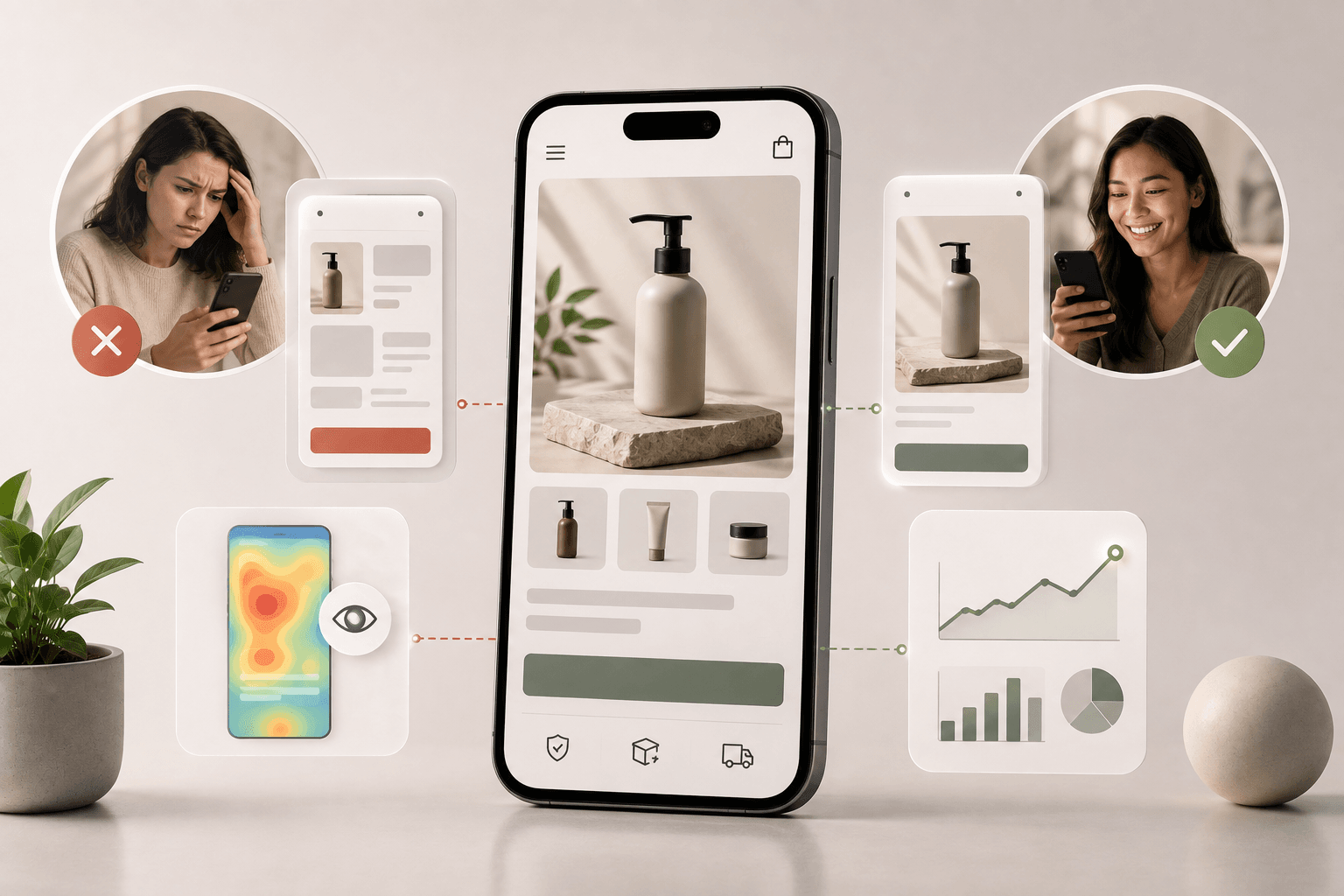
Why mobile traffic converts worse is a question with a fairly consistent, well documented answer across ecommerce, even though the specific gap size varies by store. Since mobile typically drives the majority of ecommerce traffic today, understanding and closing this gap usually represents the single largest conversion opportunity most stores are sitting on without realizing it.
The specific, documented causes
Tap target size is a frequent, underestimated cause. Buttons and links sized for a mouse cursor on desktop often become genuinely difficult to tap accurately on a phone screen, leading to mis-taps that feel to a visitor like the site is broken, even when nothing is technically wrong. Incorrect keyboard triggers compound this, a phone number field that opens a full alphabet keyboard instead of a numeric one adds friction every single time someone fills out a form.
Page weight matters disproportionately on mobile, since mobile connections are frequently slower and less consistent than the Wi-Fi a site typically gets tested on internally. A page that loads acceptably fast in a team’s office test may load noticeably slower on a real customer’s cellular connection, and that gap widens the impact of every unnecessary kilobyte of image weight or third party script.
The checkout specific mobile gap
Mobile checkout carries its own amplified friction. Typing a full card number on a phone keyboard is widely one of the highest friction moments in the entire mobile funnel, which is exactly why express payment options like Apple Pay, Google Pay, and Shop Pay matter disproportionately more on mobile than desktop, where manual card entry is comparatively less painful.
Why testing only on desktop misses most of this
A team reviewing their own site tends to default to testing on a desktop browser, since that is where most internal work happens. This means the majority of mobile specific issues, tap target sizing, keyboard behavior, real world mobile load speed, simply never get caught through normal internal review, because nobody is testing on an actual phone on an actual cellular connection the way most real customers experience the site.
Common questions
How much worse does mobile typically convert compared to desktop?
This varies significantly by store and category, but a persistent, meaningful gap is common even on well optimized sites, which is why treating it as a distinct, ongoing area of focus matters.
Is a mobile app a better solution than optimizing the mobile site?
For most stores, a well optimized mobile website delivers more value per development dollar than a native app, which carries substantially higher build and maintenance cost for a smaller share of typical return traffic.
Should I prioritize mobile speed or mobile checkout first?
Checkout friction tends to have outsized impact since visitors there have already shown strong purchase intent, but both areas usually deserve dedicated, ongoing attention rather than a one time fix.
The mobile conversion gap is rarely a mystery once you look for it specifically, tap targets, keyboard behavior, page weight, and payment friction are well documented, fixable causes. The real obstacle is usually that internal review happens on desktop, where none of these issues are visible at all.
A concrete example of the tap target problem
A button sized comfortably for a mouse cursor at 32 pixels might be genuinely difficult to tap accurately on a phone screen, especially for users with larger fingers or those using the site one handed while walking or commuting. A mis-tap that lands on the wrong element reads to a visitor as the site being broken, even though nothing is technically wrong, simply undersized for the actual input method being used.
Why real world testing matters more than office Wi-Fi testing
A page loading in under a second on a team’s office Wi-Fi connection might load noticeably slower on an actual customer’s cellular connection in an area with weaker signal. That gap between internal testing conditions and real customer conditions is exactly why relying only on internal review misses a meaningful share of genuine mobile performance issues.
A quick audit you can run today
Load your checkout on your own phone using cellular data, not Wi-Fi, and time how long it takes to reach the payment step. If that feels noticeably slower than your internal testing experience, that gap is likely affecting a meaningful share of your real mobile traffic every single day.
Every one of these causes is fixable once actually identified, which is the encouraging part of an otherwise persistent, well documented gap.
A final practical note
Repeat this mobile specific review after any significant traffic source change, since a new channel, like a shift toward more social traffic, often comes with a different device and connection mix than your existing baseline.
A shifting traffic mix can quietly reintroduce a gap that was previously closed, which makes this worth revisiting periodically.
Worth revisiting whenever your traffic sources shift meaningfully.
One more thing worth tracking
Track your mobile versus desktop conversion gap specifically over time, rather than only checking it once. A gap that widens after a site change is often the fastest signal that a new mobile specific issue has quietly appeared.
See what mobile visitors specifically experience.
Eulav reviews mobile and desktop separately and ships fixes tuned to each. Worth repeating this check whenever your traffic mix shifts meaningfully across a season or a new campaign. Worth checking this today on your own phone.
Try Eulav freeWhere Eulav fits
Make the most of every visit and see a measurable lift in your first 30 days, or get a refund. Eulav is an AI-powered revenue optimisation platform for ecommerce brands, including Shopify stores, built by a team with over a decade in DTC revenue optimisation. It scans your store, shows where you can sell more, including any hidden blockers, and measures each optimisation you approve. Each optimisation is shown to some of your visitors first, and nothing goes live without your approval.
Spending on traffic? Whether a visit came from paid, organic or email, Eulav helps it convert, so your traffic spend earns more. At 1,000 visits, lifting conversion from 2% to 2.5% turns 20 orders into 25, with no extra ad spend.
Built for your category: Shopify CRO for fashion, beauty, supplement, jewellery, footwear brands. Comparing tools? See alternatives to Intelligems, Shoplift, Hotjar, Convert.
Make the most of the traffic you already invest in. Start with free opportunity finding and 2 optimisations. No card, 60-second setup.